
Hospital-direct vs parlour wake in Hong Kong: venue, time, attendance, cost structure. Median package price HK$11,888 (19 merchants) vs HK$23,800 (17), from this site’s Price Transparency Index, audited 2026-08-07.
Last updated: 1 August 2026
When a relative has just passed away, families in Hong Kong often need a fast, clear decision: choose a hospital-direct funeral (院出 / direct cremation path without a private parlour wake), or a funeral-parlour wake (殯儀館設靈). The choice is not about which option is “more proper”. It is about venue, time, how many people can attend, and how costs are structured. If those roles are clear, a quote is comparable; if they are not, it is easy to assume the cheapest total is always right—or that a parlour hall is always required.
Important: This site is a research and navigation tool. It does not replace Food and Environmental Hygiene Department (FEHD) official lists, or hospital / mortuary instructions on the day. Licensing and government procedures follow the latest official publications.
Contents
Fast answer: A hospital-direct funeral (院出) usually means no private parlour hall rental and no traditional overnight wake. Farewell is often shorter, in a hospital farewell room or mortuary space, then the cortege goes to the crematorium or cemetery. Overall process is leaner and market totals are often lower. A parlour wake rents a licensed funeral parlour hall so more relatives and friends can pay respects, with more room for ceremony and scheduling—but hall fees, décor, and time costs are usually higher. In both paths you still typically need a licensed undertaker for transport, documents, and cremation booking. Venue and service provider are different roles—check both. See: Funeral parlour vs undertaker.
On price: according to this site’s Hong Kong Funeral Price Transparency Index 2026 (audited 7 August 2026), the median package price for a hospital or mortuary departure is HK$11,888 (19 licensed merchants sampled; observed range HK$6,300–$18,000), and for a funeral parlour wake HK$23,800 (17 merchants; observed range HK$9,980–$45,000). Both are medians of listed prices and exclude government fees (adult cremation HK$1,220, death certificate HK$140 each) and niche placement. Where one merchant lists two prices for the same service, the index takes the higher, so the median runs high. View the index | Method
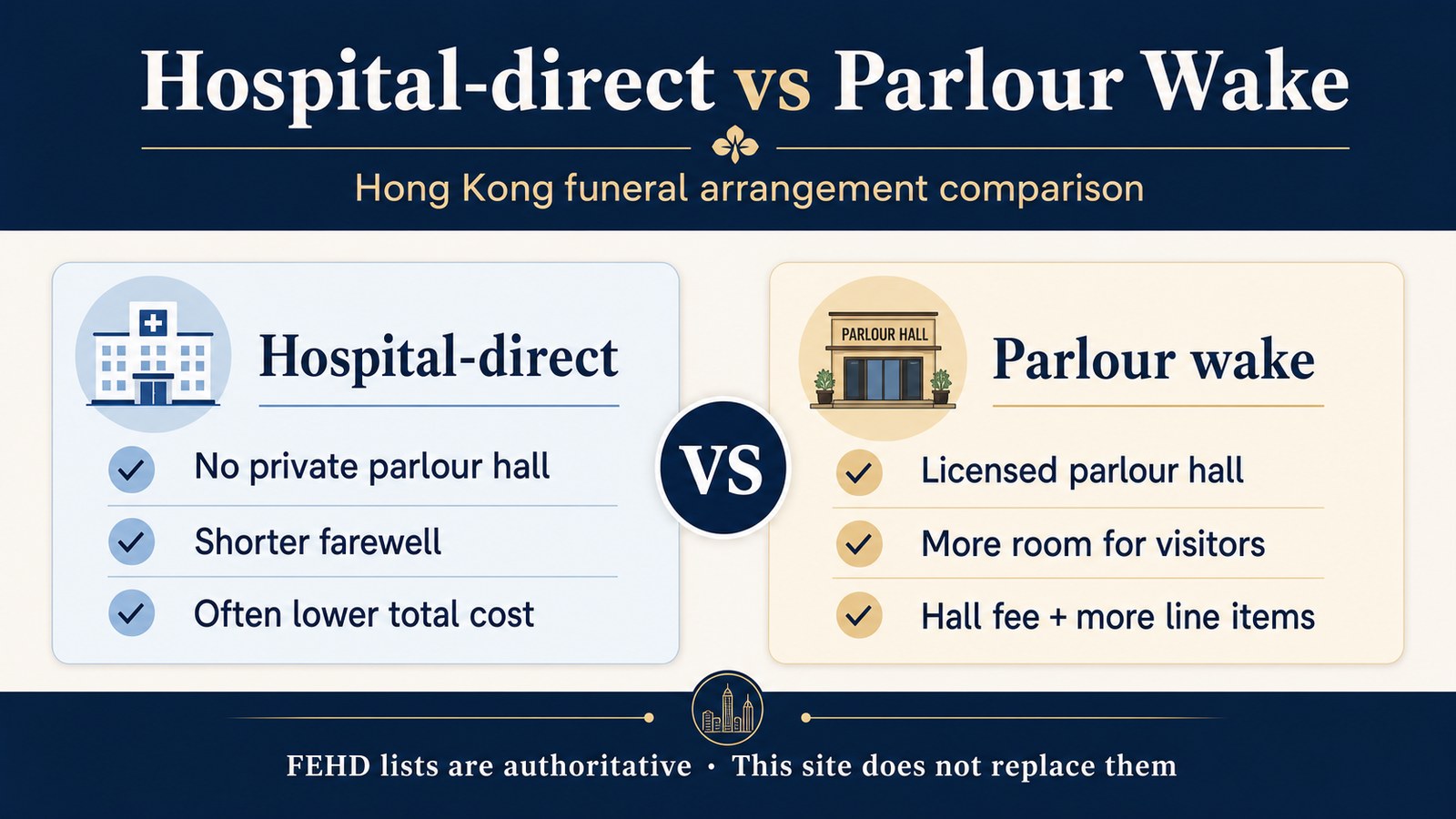
Hospital direct and a wake
Hospital direct
- No private hall
- A shorter farewell
- A shorter cost list
Parlour wake
- A parlour hall
- More space for mourners
- Hall hire plus rites
Key points
| Clarify first | Hospital-direct (院出) | Parlour wake |
|---|---|---|
| Main venue | Hospital farewell room / mortuary space (subject to hospital rules) | Licensed funeral parlour hall |
| Wake / overnight | Usually no traditional wake | Often wake then funeral the next day |
| Attendance | Often core family; limited space and time | Easier for more visitors |
| Hall fee | No private parlour hall fee | Hall fees often from thousands to tens of thousands HKD |
| Median package price (this site’s index, 2026-08-07) |
HK$11,888 (n=19 merchants) observed range $6,300–$18,000 |
HK$23,800 (n=17 merchants) observed range $9,980–$45,000 |
| What to verify | Licensed undertaker (service) | Licensed parlour (venue) + licensed undertaker (service) |
Medians come from this site’s Hong Kong Funeral Price Transparency Index 2026, audited 7 August 2026, sampling those of Hong Kong’s 146 FEHD-licensed undertakers that publish an in-date whole-package price. They are medians of listed prices, not what you will actually pay — use written itemised quotes. Government fees follow the latest FEHD notices.
What is a hospital-direct funeral?
“Hospital-direct” (院出), also called hospital funeral, direct discharge, or mortuary discharge, generally means: no private funeral-parlour hall and no traditional overnight wake. A shorter farewell is held in a hospital or public mortuary farewell space, then the coffin proceeds to the crematorium or cemetery.
- Farewell length is often about 20–60 minutes, depending on hospital rules and the day’s schedule.
- A simple religious or memorial element can still be arranged, but scale is limited by the venue.
- Even without a hall, families usually still need a licensed undertaker for transport, coffin/shroud, paperwork, and cremation booking.
You may have assumed “hospital-direct means no company at all”. What you typically save is parlour hall and wake cost structure—not the need for lawful undertaking support or government procedures.
What is a parlour wake?
A funeral-parlour wake means renting a hall at a licensed funeral parlour so relatives and friends can pay respects, with room for religious or traditional rites. A common pattern is wake on day one and funeral procession the next day, then cremation or burial.
- Suits larger visitor numbers, longer mourning time, or fuller traditional rites.
- Quotes often combine venue (hall name, slot, hall fee) and service provider (who invoices, who runs rites and transport).
- A licensed venue does not automatically mean the billing company is a licensed undertaker—check both. See: How to verify a licensed undertaker in Hong Kong.
Side-by-side comparison
| Item | Hospital-direct | Parlour wake |
|---|---|---|
| Flow | Hospital/mortuary → farewell → crematorium/cemetery | Hospital/mortuary → parlour wake → procession → crematorium/cemetery |
| Timing | Core steps often within several days (still subject to cremation slots) | Depends on hall availability; often needs more lead time |
| Ceremony flexibility | Lean; short rites possible | More room for fuller religious or traditional programmes |
| Cost structure | No private hall fee; mainly service, coffin, transport, cremation | Hall fee + décor + service + rites; more line items |
| Often fits when | You want a lean farewell, tighter budget, core family focus | More visitors, longer wake, or fuller ceremony needs |
How to read costs
Market commentary commonly places hospital-direct totals lower than parlour wakes because private hall fees drop out. That claim holds up against the data — the figures below are not industry opinion but a computation you can reproduce from published merchant prices:
| Venue | Median package price | Observed range | Sample (distinct merchants n) |
|---|---|---|---|
| Hospital / mortuary departure | HK$11,888 | $6,300–$18,000 | 19 |
| Funeral parlour wake | HK$23,800 | $9,980–$45,000 | 17 |
Audited 7 August 2026. Each rule below shapes the number; without them it cannot be reproduced:
- One figure per merchant — its own lowest package price — then the median across merchants. Otherwise a merchant listing eight packages outweighs one listing a single package.
- n counts distinct merchants, not quoted rows. A median is published only at 12 or more merchants; below that, observed range only.
- Whole funeral packages only. Per-unit line items (for example a per-shift ritual attendant rate) are excluded.
- In-date prices only — nothing older than 12 months enters the calculation.
- Where a merchant lists two prices for one service, the index takes the higher, preferring to overstate rather than understate what a family will pay. This biases the median upward and must be stated whenever the figure is cited.
What the figure excludes: government fees (adult cremation HK$1,220, death certificate HK$140 each), niche placement, and any standardisation of what each package contains. The median reflects listed price only, not what you receive for it. Treat it as a negotiating baseline, not a quote.
Sources
- Package medians: this site’s Hong Kong Funeral Price Transparency Index 2026, audited 2026-08-07; exclusion rules and computation in the methodology.
- Adult cremation HK$1,220: Food and Environmental Hygiene Department — crematoria charges.
- Death certificate HK$140: Immigration Department — registering a death.
For a finer breakdown, see: 2026 funeral pricing guide. Government cremation fees follow FEHD’s latest notices.
Note: “From” prices usually describe a basic package. Night transport, special coffins, extra rites, paper offerings, urns (骨灰盅), and niches are often extra. Itemised written quotes beat a single headline total.
Next step: Get a written itemised quote and check it against the medians above. Browse the provider directory · Licence statistics (the directory includes advertising merchants, marked “Sponsored” on their cards; this site does not rank providers.)
Five steps before you decide
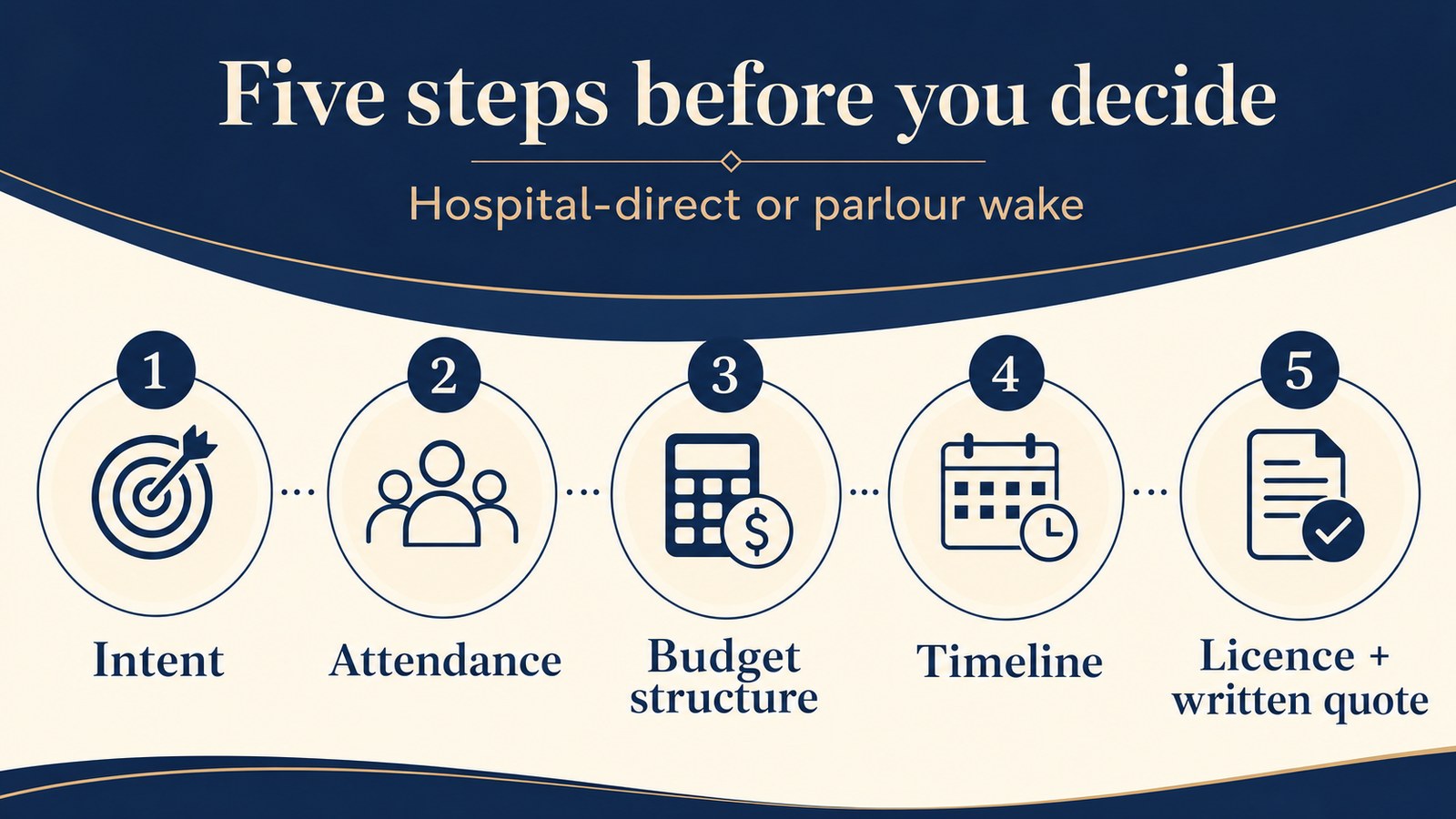
- Intent: Did the deceased leave wishes? Is a lean farewell enough, or is a longer wake needed?
- Attendance: Core family only, or many friends expected?
- Budget structure: Ask what is included—hall fee, rites, extras—not only the total.
- Timeline: Hospital farewell slots, cremation booking, and parlour hall availability must align.
- Licence + written quote: Check parlour for venue; undertaker for service. Be careful handing over original death documents before you decide.
How to verify lawful services
- Cross-check this site’s service provider directory and FEHD licensed-undertaker statistics, and always prefer FEHD’s latest official publication.
- Invoice name, contact, and payee should match the licensed trade name you verified.
- Site content is reference only. For doubts, contact FEHD or the relevant department directly.
Quotes and common traps
- If a “hospital-direct” quote claims a private parlour hall is included, ask why—direct paths usually skip private halls.
- A single package total with no line items—request itemisation before signing.
- Introducers who only say they are “close to a parlour”—still verify undertaker licensing and whether venue and service are the same entity.
- Pressure to sign or hand over originals immediately—keep room to compare; keep records of large payments.
- Mixing hall fees with service fees—different roles, different unit prices. More: How to avoid funeral black shops.
FAQ
1. What is the main difference between hospital-direct and a parlour wake?
2. Is hospital-direct always cheaper?
3. Do I still need a licensed undertaker for hospital-direct?
4. Can hospital-direct include a religious rite?
5. Does a parlour wake always mean overnight?
6. How do I check if a parlour or provider is lawful?
7. Are there government or charity support options?
How to choose
There is no single correct answer. If you want a lean core-family farewell and to avoid private hall costs, start with hospital-direct. If more visitors or a longer wake matter more, a parlour wake may fit better. In either case: separate venue from undertaker, demand written itemised quotes, and treat FEHD lists as authoritative.
Next: Funeral parlour vs undertaker, the after-death guide, and the directory.